
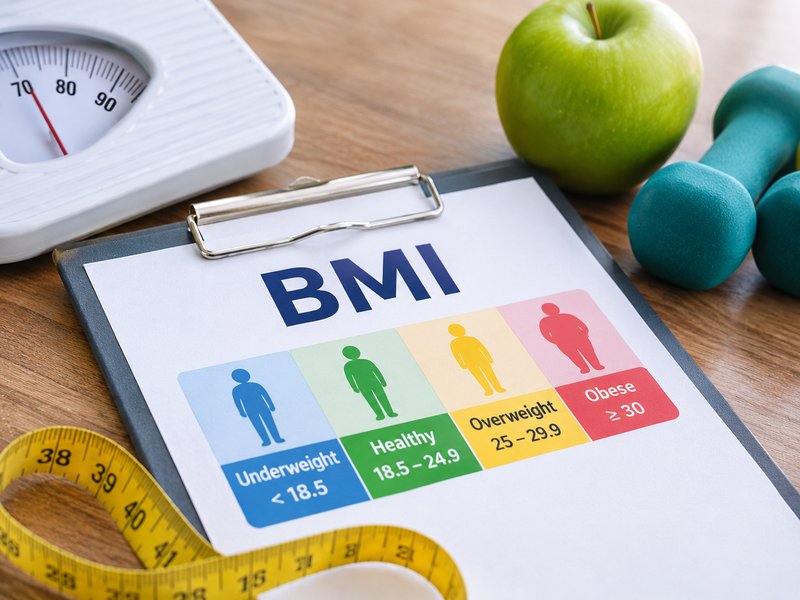
Body mass index (BMI) is a number that compares your weight with your height. For most adults, a BMI of 18.5 to 24.9 is classed as a healthy weight, 25 to 29.9 as overweight and 30 or above as obesity. It is quick, free and useful for spotting possible weight-related health risks across large groups of people. But BMI cannot tell fat from muscle, cannot show where fat sits on your body, and does not fit every age, sex or ethnic group equally well. This guide explains how to calculate it, how to read it, and what to use alongside it.
What is BMI?
BMI stands for body mass index. It was developed in the 1830s and 1840s by the Belgian mathematician Adolphe Quetelet to describe the average build of populations, and it was named BMI in 1972 by the researcher Ancel Keys. It was never designed to diagnose an individual, but because it needs only a scale and a tape measure, it became the world’s most common first check of weight status.
BMI does not measure body fat directly. It uses weight as a stand-in for body size and assumes that, for most people of a given height, heavier usually means more fat. That is true on average across a population, which is why BMI works as a rough screen, and it is also why it can be wrong about any one person.
How to calculate BMI
In metric units, divide your weight in kilograms by your height in metres, squared.
BMI = \frac{weight\ (kg)}{height\ (m)^2}In pounds and inches, multiply by 703.
BMI = 703 \times \frac{weight\ (lb)}{height\ (in)^2}Example: A person who weighs 70 kg and is 1.65 m tall has a BMI of 70 divided by 2.72 (1.65 times 1.65), which is about 25.7. Using imperial units, 154 lb at 65 inches gives the same answer, about 25.6 once rounding is allowed for. Many online calculators and phone apps will do the sum for you.
BMI chart for adults (WHO categories)
These are the international categories published by the World Health Organization and used by most health services, including the CDC and the NHS.
| BMI (kg/m2) | Category |
|---|---|
| Below 16.0 | Severe thinness |
| 16.0 to 16.9 | Moderate thinness |
| 17.0 to 18.4 | Mild thinness |
| 18.5 to 24.9 | Healthy weight |
| 25.0 to 29.9 | Overweight (pre-obesity) |
| 30.0 to 34.9 | Obesity class I |
| 35.0 to 39.9 | Obesity class II |
| 40.0 and above | Obesity class III (severe obesity) |
These categories apply to adults aged 18 and over. They are not for children, teenagers or pregnant women.
BMI ranges for Asian adults
Research shows that people of South Asian, East Asian and Southeast Asian ancestry often develop type 2 diabetes, high blood pressure and heart disease at lower BMIs than people of European ancestry, partly because they tend to carry more body fat and more fat around the abdomen at the same BMI. A WHO expert group in 2004 therefore recommended extra cut-off points at 23 and 27.5.
| BMI (kg/m2) | Asia-Pacific category |
|---|---|
| Below 18.5 | Underweight |
| 18.5 to 22.9 | Healthy weight |
| 23.0 to 27.4 | Overweight (increased risk) |
| 27.5 and above | Obesity (high risk) |
Countries do not all draw the lines in exactly the same place. India’s guidelines, for example, treat a BMI of 23 and above as overweight and 25 and above as obesity, while others use 27.5 for obesity. If you are of Asian descent, ask your doctor which scale they use, and treat a BMI of 23 as a prompt to look at your waist size, blood sugar and blood pressure rather than waiting until 25.
Healthy weight range by height
The table below shows the weight range that falls within a BMI of 18.5 to 24.9 for adults at common heights. It uses the standard international range. If you use Asian cut-offs, the upper end of your healthy range will be lower.
| Height | Healthy weight range (kg) | Healthy weight range (lb) |
|---|---|---|
| 150 cm (4 ft 11 in) | 42 to 56 kg | 92 to 124 lb |
| 155 cm (5 ft 1 in) | 44 to 60 kg | 98 to 132 lb |
| 160 cm (5 ft 3 in) | 47 to 64 kg | 104 to 141 lb |
| 165 cm (5 ft 5 in) | 50 to 68 kg | 111 to 149 lb |
| 170 cm (5 ft 7 in) | 53 to 72 kg | 118 to 159 lb |
| 175 cm (5 ft 9 in) | 57 to 76 kg | 125 to 168 lb |
| 180 cm (5 ft 11 in) | 60 to 81 kg | 132 to 178 lb |
| 185 cm (6 ft 1 in) | 63 to 85 kg | 140 to 188 lb |
| 190 cm (6 ft 3 in) | 67 to 90 kg | 147 to 198 lb |
The range is wide on purpose. Being anywhere inside it is generally considered healthy, and where you land depends on your build, age and health.
What BMI can tell you
Across large groups, BMI tracks with the risk of several conditions. Higher BMIs are linked with a greater chance of type 2 diabetes, high blood pressure, high cholesterol, heart disease, stroke, sleep apnoea, fatty liver disease, osteoarthritis and some cancers. Very low BMIs matter too. A BMI below 18.5 can point to undernutrition, an eating disorder, thyroid or digestive disease, or other illness, and is linked with weaker bones, lower immunity and fertility problems.
So BMI is a reasonable first question: is my weight likely to be affecting my health? What it cannot do is answer that question for you personally.
The limitations of BMI
BMI has real blind spots. Knowing them helps you avoid both false alarm and false reassurance.
- It cannot tell muscle from fat. Muscle is denser than fat, so athletes, weightlifters and very muscular people can have a BMI in the overweight or obese range with low body fat.
- It ignores where fat is stored. Fat around the waist and organs (visceral fat) is more harmful than fat on the hips and thighs, yet two people with the same BMI can have very different fat distribution.
- It can miss hidden risk. Some people have a normal BMI but a high body fat percentage and a large waist, sometimes called normal-weight obesity. They can still have prediabetes or high blood pressure.
- It varies by ethnicity. The same BMI can mean different body fat and different health risk in different populations, which is why Asian cut-offs exist.
- It varies by sex and age. Women generally carry more body fat than men at the same BMI. With age, people lose muscle and gain fat, so BMI can look steady while body composition worsens. For people over 70, a slightly higher BMI is often not a problem, and some clinicians use a modified range.
- It says nothing about health on its own. Fitness, diet, sleep, blood sugar, blood pressure and family history all count. A person can be fit at a higher BMI or unwell at a lower one.
- It does not suit children or pregnancy. Growth and pregnancy change the picture, so other tools are used.
Why doctors are rethinking how obesity is diagnosed
In 2025, an international expert group, the Lancet Commission on Clinical Obesity, proposed that obesity should not be diagnosed from BMI alone. It recommended confirming excess body fat with an additional measure, such as waist circumference, waist-to-hip ratio, waist-to-height ratio or a direct fat measurement. It also separated two groups: people with obesity who already have signs of illness or limits on daily function, called clinical obesity, and people with excess fat but no current organ problems, called preclinical obesity. A very high BMI of 40 or more can still be treated as sufficient on its own.
The practical message is the same one doctors have been giving for years: use BMI as a starting point, not the whole answer.
Better measures to use alongside BMI
Waist circumference
Waist size is a simple, powerful check of abdominal fat. Measure halfway between the bottom of your ribs and the top of your hip bones, after breathing out normally, with the tape snug but not tight.
| Group | Increased risk | Substantially increased risk |
|---|---|---|
| Men (European ancestry) | 94 cm (37 in) or more | 102 cm (40 in) or more |
| Women (European ancestry) | 80 cm (31.5 in) or more | 88 cm (35 in) or more |
| Asian men | 90 cm (35.5 in) or more | Higher risk as size rises |
| Asian women | 80 cm (31.5 in) or more | Higher risk as size rises |
Waist-to-height ratio
Divide your waist measurement by your height, using the same units. A ratio below 0.5 is generally healthy, which means your waist is less than half your height. It works across ages and ethnic groups and is easy to remember.
Waist-to-hip ratio
Divide your waist by your hip measurement. The WHO considers abdominal obesity to be 0.90 or above for men and 0.85 or above for women.
Health markers
Blood pressure, fasting glucose or A1C, cholesterol and triglycerides show whether your weight is actually affecting your body. For a closer look at blood sugar, see our guides to normal blood sugar levels and the A1C test. Some clinics also offer body-fat testing with bioimpedance scales or DEXA scans, which give a more direct picture of body composition.
BMI for children and teenagers
Children are still growing, and the amount of body fat considered healthy changes with age and differs between boys and girls. For ages 2 to 19, doctors use BMI-for-age percentile charts. In the CDC system, a child below the 5th percentile is underweight, from the 5th to below the 85th is a healthy weight, from the 85th to below the 95th is overweight, and the 95th percentile or above is obesity. For children under 5, the WHO uses growth standards and z-scores. Never apply the adult chart to a child, and let a paediatrician interpret the result.
What to do with your BMI
- Below 18.5: Talk to a doctor to look for a cause and check nutrition. Gaining weight steadily with enough protein, energy and strength training can help. Seek support if worry about food or body image is involved.
- 18.5 to 24.9 (or 18.5 to 22.9 using Asian cut-offs): Keep up regular activity, balanced eating and sleep. Check your waist size once or twice a year.
- 25 to 29.9 (or 23 to 27.4 using Asian cut-offs): This is a good time for gradual changes, since even a 5% to 7% loss can improve blood pressure, blood sugar and cholesterol. See our guide to calorie targets for weight loss.
- 30 and above (or 27.5 and above using Asian cut-offs): Speak with a healthcare professional about a plan that may include nutrition, activity, sleep, behaviour support and, where appropriate, medical treatment.
If your BMI sits in the healthy range but your waist is large, or your BMI is high but you are muscular and your measures are healthy, your doctor can help you interpret it. Whatever your number, it is information about risk, not a judgement of your worth. If you find yourself preoccupied with weight or body shape, tell your doctor.
When to see a doctor
Book an appointment if your BMI is below 18.5 or at 30 or above, if you are gaining or losing weight without trying, if your waist is above the risk thresholds, or if you have a family history of diabetes or heart disease. Seek help sooner if you notice breathlessness, joint pain, loud snoring with daytime tiredness, extreme thirst or frequent urination.
Final thoughts
BMI is a handy first check, not a final verdict. Calculate it, compare it with the right scale for your age and background, then look at your waist and your health markers. If your numbers raise questions, a conversation with your doctor will tell you far more than any single figure.
Discailmer: This article is for general information and is not a substitute for professional medical advice, diagnosis or treatment. Talk to a qualified healthcare provider about your weight, your BMI and your health.
Frequently Asked Questions
For most adults, a BMI of 18.5 to 24.9 is considered a healthy weight. For many Asian adults, the healthy range is 18.5 to 22.9.
It is a reasonable screening tool for groups of people, but it is only a rough guide for individuals. It cannot separate muscle from fat or show where fat is stored.
Some people with a BMI in the overweight range, particularly muscular people, have healthy blood pressure, blood sugar and cholesterol. Others do not. Checking waist size and blood tests gives a clearer answer than BMI alone.
Yes. People with a normal BMI can carry extra fat around the abdomen, have low muscle mass, or have prediabetes or high blood pressure. Waist size and health markers help catch this.
Asian populations tend to have more body fat and more abdominal fat at the same BMI, and they develop diabetes and heart disease at lower BMIs. That is why cut-offs of 23 and 27.5 or 25, depending on the country, are recommended.
The formula and standard adult categories stay the same, but body composition shifts with age. Older adults often lose muscle, so BMI may hide a fall in muscle and rise in fat. Some experts consider a slightly higher BMI acceptable after age 65 to 70.
No single measure replaces it, but waist circumference and waist-to-height ratio are the most practical additions. Together with blood pressure and blood tests, they give a fuller picture.
Once or twice a year is enough for most adults, or when your weight changes noticeably. Checking daily is not useful, since BMI changes slowly.