
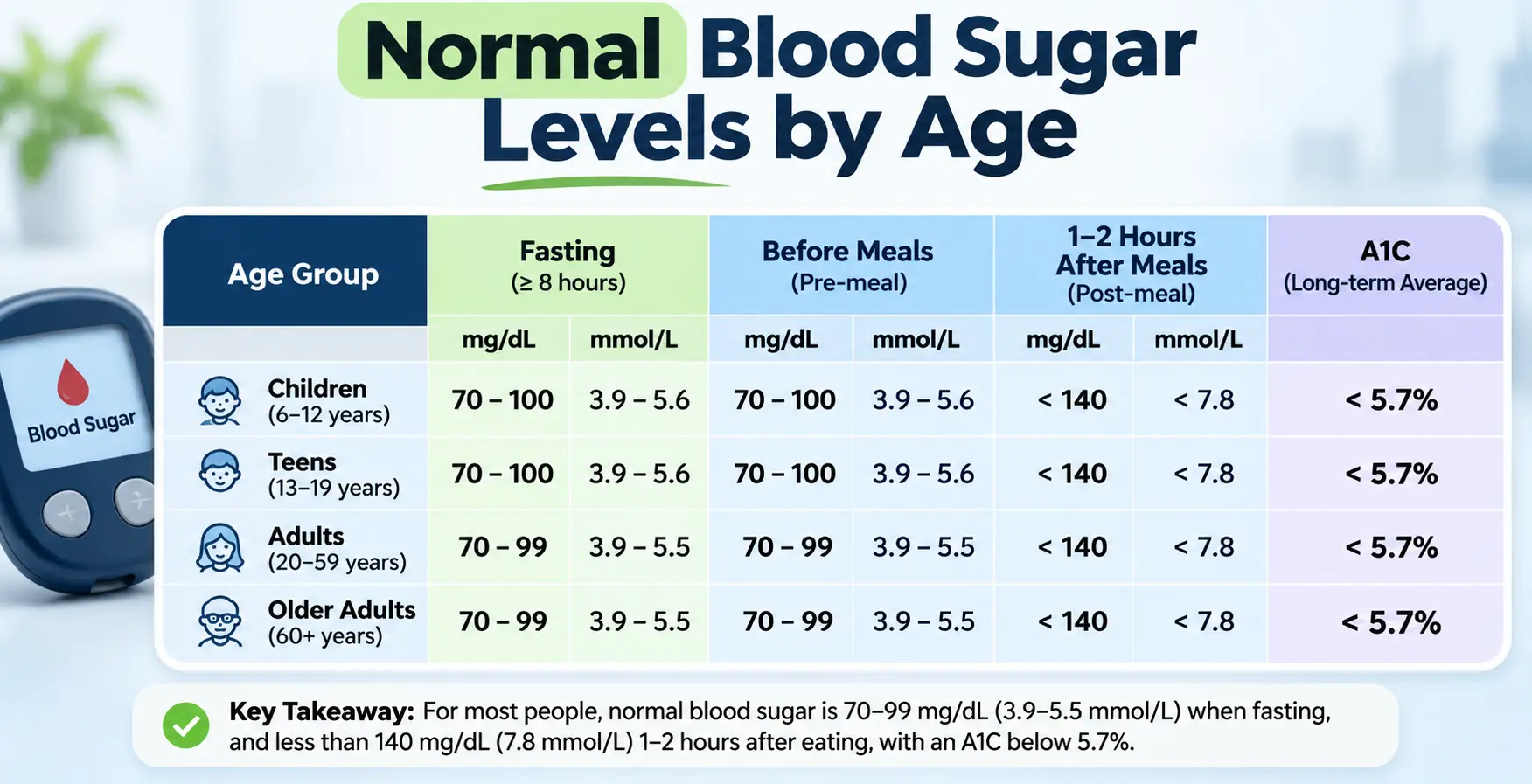
For a healthy adult, a normal fasting blood sugar is 70 to 99 mg/dL (3.9 to 5.5 mmol/L), and a normal reading two hours after eating is below 140 mg/dL (7.8 mmol/L). These numbers stay close to the same through most of life. What changes with age is not the definition of normal in people without diabetes, but the targets doctors set for people who have diabetes. Children, pregnant women and older adults each have their own goals. This guide lays out the charts for every group in both mg/dL and mmol/L.
Key takeaways
- Normal fasting blood sugar for most children and adults without diabetes is 70 to 99 mg/dL (3.9 to 5.5 mmol/L).
- Two hours after a meal, blood sugar should be below 140 mg/dL (7.8 mmol/L).
- A fasting level of 100 to 125 mg/dL (5.6 to 6.9 mmol/L) falls in the prediabetes range, and 126 mg/dL (7.0 mmol/L) or higher on two tests points to diabetes.
- For adults with diabetes, a common target is 80 to 130 mg/dL (4.4 to 7.2 mmol/L) before meals and under 180 mg/dL (10.0 mmol/L) one to two hours after meals.
- Older adults and pregnant women follow different targets, and children’s goals are set by their care team.
- To convert, multiply mmol/L by 18 to get mg/dL, or divide mg/dL by 18 to get mmol/L.
Normal blood sugar levels chart for adults without diabetes
This is the chart most people are looking for. It applies to healthy adults and, in general, to children and teenagers without diabetes.
| When you test | Normal | Prediabetes | Diabetes |
|---|---|---|---|
| Fasting (at least 8 hours without food) | 70 to 99 mg/dL (3.9 to 5.5 mmol/L) | 100 to 125 mg/dL (5.6 to 6.9 mmol/L) | 126 mg/dL or higher (7.0 mmol/L or higher) |
| 2 hours after a 75 g glucose drink | Below 140 mg/dL (below 7.8 mmol/L) | 140 to 199 mg/dL (7.8 to 11.0 mmol/L) | 200 mg/dL or higher (11.1 mmol/L or higher) |
| A1C (average of about 3 months) | Below 5.7% (below 39 mmol/mol) | 5.7% to 6.4% (39 to 46 mmol/mol) | 6.5% or higher (48 mmol/mol or higher) |
| Random (any time of day) | Usually below 140 mg/dL (below 7.8 mmol/L) | Not used to diagnose prediabetes | 200 mg/dL or higher (11.1 mmol/L or higher) with symptoms |
These cut-offs follow American Diabetes Association criteria. Some countries use slightly different thresholds. The World Health Organization, for example, places the start of impaired fasting glucose at 110 mg/dL (6.1 mmol/L). A single abnormal result is normally confirmed with a repeat test before a diagnosis is made. If your numbers fall in the prediabetes range, our guide to prediabetes explains what to do next.
Blood sugar levels by time of day
Blood sugar is never one fixed number. It rises after you eat and falls as insulin does its work. For a person without diabetes, typical patterns look like this:
| Time | Typical level without diabetes |
|---|---|
| Fasting, on waking | 70 to 99 mg/dL (3.9 to 5.5 mmol/L) |
| Before meals | 70 to 99 mg/dL (3.9 to 5.5 mmol/L) |
| 1 hour after eating | Often peaks below 140 mg/dL (7.8 mmol/L) |
| 2 hours after eating | Below 140 mg/dL (7.8 mmol/L) |
| Bedtime | 80 to 120 mg/dL (4.4 to 6.7 mmol/L) |
| Overnight | 70 to 100 mg/dL (3.9 to 5.6 mmol/L) |
These are typical patterns rather than strict diagnostic cut-offs. A healthy reading can briefly climb higher after a large, carbohydrate-heavy meal and then settle back within a couple of hours.
Blood sugar levels by age group
Newborns and infants
Newborn babies have their own rules. Blood sugar often dips in the first hours after birth, and hospital teams monitor it closely, especially for premature babies, babies born to mothers with diabetes and babies who are small or large for their gestational age. Adult charts do not apply here. If you are worried about a baby who is unusually sleepy, feeding poorly, jittery or limp, seek medical care straight away.
Children and teenagers (without diabetes)
For children from toddlerhood through the teen years, normal fasting blood sugar is generally about 70 to 99 mg/dL (3.9 to 5.5 mmol/L), the same as adults. Blood sugar after meals is usually below 140 mg/dL (7.8 mmol/L).
Children and teenagers with diabetes
Children with type 1 or type 2 diabetes are given individual targets by their paediatric diabetes team. Many guidelines aim for an A1C of about 7% (53 mmol/mol) when it can be reached safely. Targets may be set higher for very young children or for anyone with a history of severe low blood sugar. Never adjust a child’s insulin or targets without their care team.
Adults aged 18 to 64
Healthy adults without diabetes follow the standard chart above. Adults with diabetes commonly aim for:
| Measurement | Common target for adults with diabetes |
|---|---|
| Fasting or before meals | 80 to 130 mg/dL (4.4 to 7.2 mmol/L) |
| 1 to 2 hours after the start of a meal | Below 180 mg/dL (below 10.0 mmol/L) |
| A1C | Below 7% (below 53 mmol/mol) for many adults |
Your doctor may set a tighter or looser goal depending on your health, your medicines and your risk of low blood sugar.
Adults aged 65 and older
In people without diabetes, the diagnostic ranges do not change at 65. Fasting glucose and A1C tend to drift up slightly with age, but doctors still use the same cut-offs to diagnose prediabetes and diabetes.
For older adults who have diabetes, goals are relaxed as health becomes more complex, mainly to avoid dangerous low blood sugar, which raises the risk of falls, confusion and hospital stays. The American Diabetes Association groups older adults like this:
| Health status | A1C goal | Fasting or before meals | Bedtime |
|---|---|---|---|
| Healthy, few other conditions, independent | Below 7.0% to 7.5% (53 to 58 mmol/mol) | 80 to 130 mg/dL (4.4 to 7.2 mmol/L) | 80 to 180 mg/dL (4.4 to 10.0 mmol/L) |
| Complex or intermediate health, several conditions or some difficulty with daily tasks | Below 8.0% (64 mmol/mol) | 90 to 150 mg/dL (5.0 to 8.3 mmol/L) | 100 to 180 mg/dL (5.6 to 10.0 mmol/L) |
| Very complex or poor health, long-term care, advanced illness or significant cognitive decline | Avoid relying on A1C; focus on avoiding lows and symptoms of high sugar | 100 to 180 mg/dL (5.6 to 10.0 mmol/L) | 110 to 200 mg/dL (6.1 to 11.1 mmol/L) |
Some national guidelines use slightly different numbers, for example an upper A1C goal of 8.5% for older adults in poor health. The principle is the same: the sicker or frailer the person, the more the goal shifts from tight control toward safety and quality of life.
Pregnancy
Blood sugar targets are stricter in pregnancy because high levels can affect both the mother and the baby. For women with gestational diabetes, the American Diabetes Association recommends keeping readings at or below the following:
| Time | Target in pregnancy |
|---|---|
| Fasting | Below 95 mg/dL (below 5.3 mmol/L) |
| 1 hour after meals | Below 140 mg/dL (below 7.8 mmol/L) |
| 2 hours after meals | Below 120 mg/dL (below 6.7 mmol/L) |
Targets for women who already had type 1 or type 2 diabetes before pregnancy are set by their healthcare team and may differ.
A1C to average blood sugar chart
The A1C test reflects your average blood sugar over about three months. Labs and meters can convert it into an estimated average glucose (eAG), which makes it easier to compare with daily readings.
| A1C | Estimated average glucose |
|---|---|
| 5% (31 mmol/mol) | 97 mg/dL (5.4 mmol/L) |
| 6% (42 mmol/mol) | 126 mg/dL (7.0 mmol/L) |
| 7% (53 mmol/mol) | 154 mg/dL (8.6 mmol/L) |
| 8% (64 mmol/mol) | 183 mg/dL (10.2 mmol/L) |
| 9% (75 mmol/mol) | 212 mg/dL (11.8 mmol/L) |
| 10% (86 mmol/mol) | 240 mg/dL (13.4 mmol/L) |
The link between A1C and daily readings is an average, so your own numbers may not match the table exactly. Conditions such as anaemia, kidney disease and some inherited haemoglobin variants can make A1C less reliable, and your doctor may use other tests alongside it.
What counts as low blood sugar?
Low blood sugar, or hypoglycaemia, is generally defined as a reading below 70 mg/dL (3.9 mmol/L). A reading below 54 mg/dL (3.0 mmol/L) is considered clinically significant and needs prompt treatment. Common signs include shakiness, sweating, fast heartbeat, hunger, dizziness, irritability and blurred vision. Severe lows can cause confusion, seizures or loss of consciousness.
A widely used first step for a person who is awake and able to swallow is the “15-15 rule”: take 15 grams of fast-acting carbohydrate such as glucose tablets or fruit juice, wait 15 minutes, then recheck. Repeat if still low, and follow it with a snack or meal once levels recover. If someone cannot swallow safely or is unresponsive, call emergency services.
What counts as high blood sugar?
High blood sugar, or hyperglycaemia, is a reading above your target. For many people with diabetes that means fasting levels above 130 mg/dL (7.2 mmol/L) or levels above 180 mg/dL (10.0 mmol/L) after meals. Symptoms include increased thirst, frequent urination, tiredness and blurred vision. Repeated readings above 250 mg/dL (13.9 mmol/L), especially with vomiting, stomach pain, fast breathing or fruity-smelling breath, can signal a serious complication and need urgent medical attention.
What affects your blood sugar?
Many things push your reading up or down on a given day:
- Food: The amount and type of carbohydrate matters most, but fibre, protein and fat slow the rise.
- Physical activity: Exercise usually lowers blood sugar, sometimes for many hours afterward.
- Stress and illness: Stress hormones and infections can raise glucose.
- Sleep: Poor or short sleep increases insulin resistance.
- Medicines: Insulin and some diabetes drugs lower blood sugar. Steroids can raise it.
- Alcohol: It can cause delayed drops, especially on an empty stomach.
- Time of day: Many people see a natural morning rise caused by hormones, sometimes called the dawn phenomenon.
How to check your blood sugar
You can check at home with a fingerstick glucose meter, which gives a reading in seconds. Some people use a continuous glucose monitor (CGM), a small sensor that tracks levels day and night. A laboratory test, such as a fasting glucose or A1C, is used for diagnosis. Wash and dry your hands before a fingerstick, as sugary residue from food can falsely raise the result. Home meters are meant for monitoring, so any result that suggests diabetes should be confirmed with a lab test.
When to see a doctor
See a healthcare provider if your fasting readings are repeatedly 100 mg/dL (5.6 mmol/L) or higher, if you have risk factors for diabetes such as family history, excess weight or a history of gestational diabetes, or if you notice constant thirst, frequent urination, unexplained weight loss or slow-healing wounds. Seek urgent care for repeated lows that do not respond to treatment, confusion, seizures, or very high readings with vomiting or abdominal pain.
Final thoughts
Knowing your numbers is the first step to protecting your health. Normal blood sugar is much the same from childhood to old age, but the goals for managing diabetes shift with age, pregnancy and overall health. Keep this chart handy, use the unit your meter shows, and bring any readings that worry you to your doctor.
This article is for general information and is not a substitute for professional medical advice, diagnosis or treatment. Targets are individual, so follow the plan set by your own healthcare provider.
Frequently Asked Questions
For people without diabetes, normal fasting blood sugar is about 70 to 99 mg/dL (3.9 to 5.5 mmol/L) at every age from childhood through older adulthood. What varies by age and health is the target set for people who have diabetes.
Two hours after a meal, a normal level is below 140 mg/dL (7.8 mmol/L). It often peaks between 30 and 60 minutes after eating, and it can briefly exceed 140 mg/dL without being a problem.
Below 54 mg/dL (3.0 mmol/L) is significantly low and needs prompt treatment. Readings that stay above 250 mg/dL (13.9 mmol/L), especially with symptoms, need medical advice, and levels above 300 mg/dL (16.7 mmol/L) with vomiting or breathing changes are an emergency.
If you do not have diabetes, the normal fasting range is the same as for younger adults: 70 to 99 mg/dL (3.9 to 5.5 mmol/L). If you have diabetes, your target depends on your overall health, and may be a little higher than for younger adults.
As a fasting reading, 6.0 mmol/L (108 mg/dL) is in the prediabetes range. After a meal, 6.0 mmol/L is normal.
After eating, 140 mg/dL (7.8 mmol/L) is at the upper edge of normal. If you have not eaten for hours, it is higher than expected and worth discussing with a doctor.
Fasting glucose and A1C often creep up gradually as we get older, partly because of weight gain, less muscle and lower activity. Staying active and keeping a healthy weight helps slow this.