
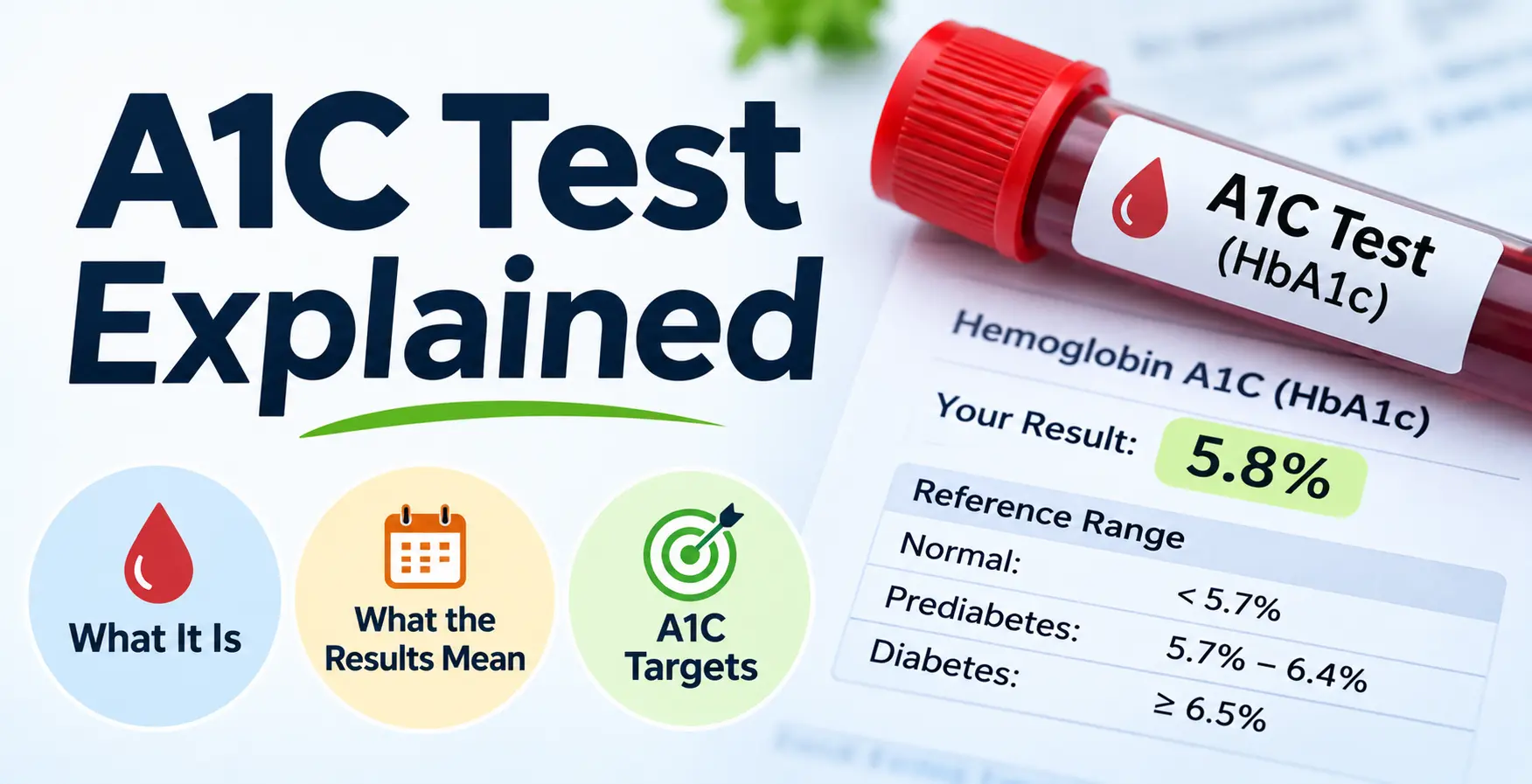
The A1C test is a blood test that shows your average blood sugar over the past two to three months. Your result is a percentage: below 5.7% (39 mmol/mol) is normal, 5.7% to 6.4% (39 to 46 mmol/mol) signals prediabetes, and 6.5% (48 mmol/mol) or higher points to diabetes. Because it needs no fasting and captures a long-term average rather than a single moment, it is one of the most widely used tests for finding and tracking diabetes. This guide explains what the number means, how to read it, and what can make it misleading.
What is the A1C test?
The A1C test goes by several names: HbA1c, haemoglobin A1C, glycated haemoglobin and glycosylated haemoglobin. They all mean the same thing.
Here is how it works. Haemoglobin is the protein inside red blood cells that carries oxygen. Whenever there is glucose in your blood, some of it sticks to haemoglobin, a process called glycation. The more sugar in your blood, the more haemoglobin becomes coated. The A1C test measures the percentage of your haemoglobin that is coated.
Red blood cells live for roughly three months, so the result reflects your average blood sugar across that period. It is weighted toward the most recent weeks, which means the last month or so influences the number more than the earliest part of the window.
This is what makes A1C different from a finger-prick reading. A meter shows your blood sugar at one moment. A1C shows the overall pattern, so one big meal or one stressful morning will not swing it much.
A1C chart: normal, prediabetes and diabetes ranges
These ranges follow American Diabetes Association criteria and are used in most countries, with small differences in some national guidelines.
| A1C result | What it means |
|---|---|
| Below 5.7% (below 39 mmol/mol) | Normal |
| 5.7% to 6.4% (39 to 46 mmol/mol) | Prediabetes |
| 6.5% or higher (48 mmol/mol or higher) | Diabetes |
A1C is reported in two ways. The percentage (NGSP or DCCT units) is used in the United States and many other countries. The millimoles per mole figure (IFCC units) is used in the UK, much of Europe and Australia. Both describe the same result, so check which one your lab report shows.
What does your A1C number mean?
A more detailed look at where your number falls:
| A1C | What it generally suggests |
|---|---|
| Below 5.7% (below 39 mmol/mol) | Blood sugar is in the normal range. Repeat screening about every 3 years if you are an adult at average risk. |
| 5.7% to 6.4% (39 to 46 mmol/mol) | Prediabetes. Lifestyle changes can bring it down, and testing at least once a year is advised. |
| 6.5% to 6.9% (48 to 52 mmol/mol) | In the diabetes range. Confirmation testing is needed if you have no symptoms. For people already treated, this may be near target. |
| 7.0% to 7.9% (53 to 63 mmol/mol) | Above normal, and a common treatment target for many adults with diabetes is just below 7%. |
| 8.0% to 9.9% (64 to 85 mmol/mol) | Blood sugar is running high. A review of treatment and lifestyle is usually recommended. |
| 10% or higher (86 mmol/mol or higher) | Very high. Speak with your doctor promptly, because the risk of complications rises with persistently high levels. |
A single result is a snapshot. Your doctor will look at it alongside your symptoms, other blood tests and your medical history.
A1C to average blood sugar conversion
Labs and meters can convert your A1C into an estimated average glucose (eAG), which lets you compare it with your daily readings.
| A1C | Estimated average glucose |
|---|---|
| 5% (31 mmol/mol) | 97 mg/dL (5.4 mmol/L) |
| 6% (42 mmol/mol) | 126 mg/dL (7.0 mmol/L) |
| 7% (53 mmol/mol) | 154 mg/dL (8.6 mmol/L) |
| 8% (64 mmol/mol) | 183 mg/dL (10.2 mmol/L) |
| 9% (75 mmol/mol) | 212 mg/dL (11.8 mmol/L) |
| 10% (86 mmol/mol) | 240 mg/dL (13.4 mmol/L) |
| 11% (97 mmol/mol) | 269 mg/dL (14.9 mmol/L) |
| 12% (108 mmol/mol) | 298 mg/dL (16.5 mmol/L) |
Every 1 percentage point rise in A1C corresponds to roughly 29 mg/dL (1.6 mmol/L) higher average glucose. These figures are averages across large groups, so your own daily readings may not match the table exactly.
How the A1C test is done
The test is simple and quick:
- No fasting is needed. You can eat and drink normally beforehand.
- A small blood sample is taken, usually from a vein in your arm, and sent to a laboratory. Some clinics use a finger-prick point-of-care device that gives a result in minutes.
- Results typically come back within a day or two for a lab test.
There is no special preparation, but tell your doctor about any anaemia, kidney or liver disease, recent blood loss or transfusion, pregnancy and any medicines or supplements you take, since these can affect interpretation.
A1C targets for people with diabetes
The right target is personal. It balances the benefit of lower blood sugar against the risk of dangerous lows. Typical goals are:
| Group | Common A1C goal |
|---|---|
| Many non-pregnant adults | Below 7% (below 53 mmol/mol) |
| Healthy older adults | Below 7.0% to 7.5% (53 to 58 mmol/mol) |
| Older adults with several health conditions | Below 8.0% (below 64 mmol/mol) |
| Older adults in very poor health | Avoid relying on A1C; focus on avoiding lows and symptoms of high sugar |
| Children and teens | About 7% (53 mmol/mol), set by the paediatric diabetes team |
| Pregnancy | Often below 6% to 7% (42 to 53 mmol/mol) depending on safety, with glucose monitoring used alongside |
Some people can safely aim lower, for example under 6.5% (48 mmol/mol), while others need a looser goal. Your doctor will set yours. For more on daily targets by age, see our guide to normal blood sugar levels by age.
How often should you have an A1C test?
Frequency depends on your situation:
- No diabetes, normal result: about every 3 years for adults at average risk, sooner if you have risk factors.
- Prediabetes: at least once a year, and more often if you are working to lower it.
- Diabetes at target and stable: at least twice a year.
- Diabetes with a recent treatment change or not at target: about every 3 months.
Because red blood cells turn over about every three months, testing more often than that rarely shows real change.
Why A1C can be inaccurate
A1C is reliable for most people, but some conditions interfere with it. Always mention these to your doctor:
- Anaemia: The effect depends on the cause. Iron-deficiency anaemia can raise A1C, while anaemias that shorten red blood cell life, such as haemolytic anaemia, can lower it.
- Haemoglobin variants: Inherited variants such as sickle cell trait and thalassaemia can give falsely high or low results with some lab methods. They are more common in people of African, Mediterranean and Southeast Asian ancestry.
- Chronic kidney disease: Changes in red blood cell turnover can skew the result in either direction.
- Pregnancy: Increased red blood cell turnover and blood dilution can lower A1C, so glucose tests are often preferred.
- Recent blood loss or transfusion: These can make A1C look lower than your true average.
- Some medicines: Treatments that boost red blood cell production can lower A1C.
If you have any of these, your doctor may rely on fasting glucose, a glucose tolerance test, a continuous glucose monitor, or a different lab method instead.
A1C vs fasting glucose vs CGM
No single test tells the whole story:
| Test | What it shows | Fasting needed? |
|---|---|---|
| A1C | Average blood sugar over about 3 months | No |
| Fasting glucose | Blood sugar after at least 8 hours without food | Yes |
| Glucose tolerance test | How your body handles a 75 g glucose drink over 2 hours | Yes |
| Home meter | Blood sugar at one moment | No |
| Continuous glucose monitor (CGM) | Readings day and night, including time in range | No |
CGM users may also see a glucose management indicator (GMI), an A1C-style estimate from sensor data. It can differ from a lab A1C by half a point or more, because the two measure blood sugar in different ways. That gap does not mean either is wrong.
Why your A1C may not match your meter readings
It is common to feel puzzled when A1C and daily readings tell different stories. Several things can explain it:
- You mostly test fasting, but your highs come after meals, which A1C captures and a morning reading misses.
- You have frequent overnight lows and daytime highs that average out to a moderate number.
- A condition such as anaemia or a haemoglobin variant is distorting the A1C.
- Your meter or test strips are slightly inaccurate.
If the two keep disagreeing, ask your doctor to look at both, and consider a CGM to see the full pattern.
How to lower your A1C
A1C moves slowly, so give changes at least three months. The habits that help most are the same ones that reverse prediabetes:
- Lose weight if you carry extra. Losing 5% to 7% of body weight improves insulin sensitivity.
- Move regularly. Aim for about 150 minutes of moderate activity a week, plus strength training twice a week.
- Eat more fibre and whole foods. Build meals around vegetables, legumes, whole grains and lean protein, and limit sugary drinks and ultra-processed food.
- Sleep well and manage stress. Poor sleep and chronic stress raise blood sugar.
- Take medicines as prescribed. If you use insulin or tablets, do not skip or change doses without your doctor.
- Track your numbers. Regular checks, or a CGM, show which foods and routines move your levels.
See our guide to reversing prediabetes for a step-by-step plan.
Can you take an A1C test at home?
Home A1C kits exist, usually using a finger-prick sample. They can be handy for tracking, but they are generally less accurate than lab tests and are not recommended for diagnosing diabetes. If a home result is high or surprising, confirm it with a laboratory test.
When to see a doctor
Book a test if you have risk factors such as overweight, family history of diabetes, age 35 or older, a history of gestational diabetes or PCOS. See your doctor promptly if your A1C is 6.5% (48 mmol/mol) or higher, or if you notice excessive thirst, frequent urination, blurred vision, unexplained weight loss or slow-healing wounds. If you already have diabetes and your A1C keeps rising despite treatment, ask for a review of your plan.
Final thoughts
The A1C test gives a clear, no-fuss picture of your long-term blood sugar. Know your number, know your target, and recheck on schedule. If your result is high, it is a signal to act, not a verdict, and steady changes in eating, activity and sleep can move it in the right direction.
Disclaimer: This article is for general information and is not a substitute for professional medical advice, diagnosis or treatment. Targets and test choices are individual, so follow the plan set by your own healthcare provider.
Frequently Asked Questions
A normal A1C is below 5.7% (39 mmol/mol). Results of 5.7% to 6.4% (39 to 46 mmol/mol) are in the prediabetes range, and 6.5% (48 mmol/mol) or higher is in the diabetes range.
There is no single cut-off, but risk of complications rises as A1C climbs. Levels of 9% (75 mmol/mol) or higher usually call for prompt treatment changes, and anyone with very high readings plus vomiting, abdominal pain, fast breathing or confusion needs urgent care.
No. You can eat and drink normally before the test, and it can be done at any time of day.
A result of 6.5% (48 mmol/mol) or higher usually needs confirmation with a repeat test on another day, or a different test such as fasting glucose, unless you have clear symptoms of high blood sugar.
A1C reflects about three months, so you will usually see the full effect of changes after 3 months. Some improvement can show earlier because recent weeks count the most.
A1C tends to rise slightly with age, but the diagnostic ranges stay the same. What changes with age is the target set for people who have diabetes.
It is the lowest value in the prediabetes range. It is a warning to improve habits and recheck, not a diagnosis of diabetes.
A short rough patch has little effect, since A1C averages about three months. Months of high stress, poor sleep or sugary eating can raise it.